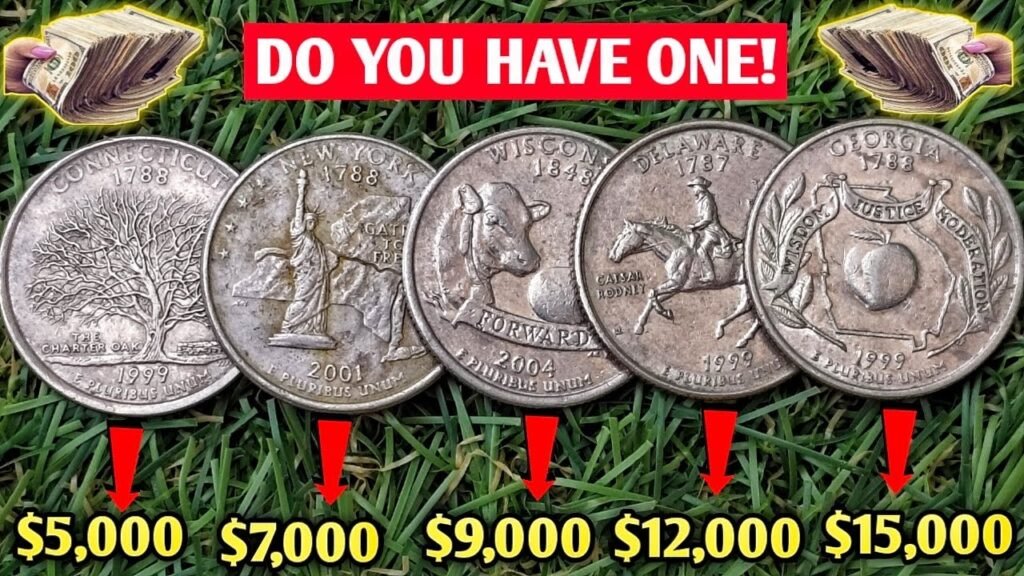
We see them every day. They jingle in our pockets, get tossed into jars, and are handed back as change without a second thought. The humble Washington quarter, a workhorse of American currency since 1932, feels about as exciting as loose lint. But what if I told you that some of these common coins are secretly rare treasures? Hidden in plain sight are specific dates, mint marks, and bizarre mistakes that can transform a 25-cent piece into a coin worth a used car, a year of college tuition, or even a down payment on a house. We’re not talking about ancient relics, but coins from the 20th and 21st centuries that you might have spent yesterday. Let’s dig into the details and learn how to spot these hidden gems.
Table of Contents
ToggleThe Alchemy of Coin Value: It’s All in the Details

Before we get to the list, you need to know why a quarter can be worth $50,000 while billions of others are worth face value. Three factors combine to create a valuable coin:
-
Key Dates: Years when very few coins were minted, often during the Great Depression or war years.
-
Mint Marks: The tiny letter on the coin showing where it was made. “D” for Denver, “S” for San Francisco, and sometimes no mint mark for Philadelphia. A different mint can mean everything.
-
Errors: Mistakes in the minting process. These are often one-of-a-kind and highly sought after by collectors.
Your most important tool? Your eyes. Get a cheap magnifying glass and learn to look closely. Condition is king—a worn, scratched coin loses most of its potential value. We’re looking for coins in sharp, clean condition, often called “Uncirculated” or “Mint State.”
9 Rare Washington Quarters: The Checklist
| Coin Date & Mint Mark | Why It’s Valuable | Estimated Value (Circulated to Mint State) |
|---|---|---|
| 1932-D | The “Key Date.” Lowest mintage of the entire series. | $150 – $14,500 |
| 1932-S | The other key first-year coin. Almost as rare as the 1932-D. | $125 – $7,000 |
| 1934 Doubled Die Obverse | A major mint error. Strong doubling visible on “IN GOD WE TRUST.” | $500 – $30,000+ |
| 1937 Doubled Die Obverse | Dramatic doubling on the date and lettering. A famous error. | $400 – $25,000+ |
| 1942-D (with “42 over 41”) | 1941 dies were reused, creating a visible “2” over a “1” in the date. | $200 – $15,000 |
| 1950-D/S (Repunched Mintmark) | A “D” mint mark punched over an “S.” Visible under magnification. | $50 – $8,000 |
| 1964-D (Special Mint Set) | Not for circulation. Special coins with a satiny “proof-like” finish. | $20 – $5,000 |
| 1970-S (Proof, Small Date) | Only found in proof sets. A subtle difference in the size of the date. | $15 – $4,000 |
| 1982-P & 1983-P (No Mintmark) | Philadelphia mint accidentally left its “P” mark off these years. | $10 – $500+ |
Better Latest Content in Middle
Now, let’s focus on the real-world tips you can use right now. The most exciting finds aren’t always from the 1930s. Modern errors are slipping out of the mint and into your change more often than you think.
The Modern Hunt: What to Look For Today
Start by checking every quarter you get from 1965 onward. Reject the notion that “all modern coins are worthless.” Look for these telltale signs:
-
Missing Clad Layer: Does the coin look brassy or copper-colored around the edge? The quarter is a “copper-nickel sandwich.” If the outer silver-colored layer is missing, it’s an error.
-
Off-Center Strikes: Is the design crooked? Is part of it cut off by the edge of the coin? Even a 5% off-center strike can double or triple the coin’s value.
-
Die Cracks: Look for raised, jagged lines on the coin’s surface. These are cracks in the stamping die that filled with metal.
सम्बंधित ख़बरें
 2026 Toyota Prado Unveiled – Bold New Design, Hybrid Power, Premium Comfort and Advanced Off-Road Technology
 2026 Volvo XC60 Hybrid: A Premium SUV Blending Fuel Efficiency, Safety and Scandinavian Style
 New 2026 Ford F 150 Launched with Smarter Technology, Improved Mileage and Modern Styling
 Yamaha Electric Cycle Revealed: High-Performance 350W Motor, Long 580KM Range and Lightning-Fast Charging
 2026 Ford Motorhome Revealed: Next-Level Luxury RV With Smart Tech, Massive Space & Powerful DrivePowerd By Teckshop⚡
 -
The “W” Mint Mark (2019-2020): Quarters from West Point mint (marked with a W) were released into circulation as a surprise. They are much rarer than their Philadelphia or Denver counterparts and can be worth $25 to $50 even in used condition.
The “Condition” Reality Check
You might find a 1932-S quarter, but if it’s worn smooth from decades of use, it’s not going to buy you a new car. It might still be worth $100 or more, which is fantastic for a quarter, but not life-changing. The astronomical values you see online ($14,500 for a 1932-D) are for coins that look like they were struck yesterday—sharp details, full luster, no scratches. This is why people search through bank rolls: to find uncirculated coins that have never been touched.
Where and How to Search
Your treasure hunt starts at home. Empty that old jar of change. Ask older relatives if they have any coin collections tucked away. Then, get a box of quarter rolls from your bank. Go through them carefully under good light. It’s a relaxing hobby with the potential for a huge payoff. If you find a coin that matches one of the key dates or has a strange error, don’t clean it! Cleaning destroys the surface and kills the value. Put it in a protective plastic holder (available cheaply online) and get it evaluated by a reputable coin dealer or certified by a service like PCGS or NGC.
Frequently Asked Questions (FAQs)
1. I found an old silver quarter. Is it worth more?
Yes, but not just because of the silver. Quarters minted in 1964 and earlier are 90% silver. Their melt value is currently around $4-$5. However, if it’s a key date (like a 1932-D) in good condition, its value as a collectible far exceeds its silver value.
2. What’s the most valuable Washington quarter ever sold?
While private sales can vary, the top-tier specimens are the pristine 1932-D and 1932-S quarters. High-grade examples of major errors, like the 1934 Doubled Die, have also sold for well over $30,000 at auction.
3. Are quarters from the 1970s and 80s worth anything?
Most are worth only 25 cents. The major exceptions are the 1982-P and 1983-P with no mint mark, and any coin with a clear, dramatic mint error. Always check for those missing clad layers or off-center strikes.
4. What does “proof” mean?
Proof coins are specially made for collectors. They have a mirror-like background and frosty-looking design. They are struck multiple times for sharp detail and come in sealed sets. They were not meant for circulation, so a proof coin found in your change is unusual.
5. I think I found a valuable coin. What’s my next step?
First, compare it closely to photos online of known rare coins or errors. Use a magnifying glass. If you’re still convinced, take it to a local coin shop (look for positive reviews) for a free opinion. For truly potential high-value coins, consider submitting it to a professional grading service for authentication and encapsulation.
The next time you get a quarter in change, take a two-second glance. Check the date. Look for a mint mark. See if anything looks odd or doubled. That simple habit could be the difference between spending a piece of history and discovering a small fortune that was hiding in your hand all along. Happy hunting